The Bell: Cast Iron That Won't Pretend
There is a moment, the first time you pick up a kettlebell, when the wrist registers an objection. The mass is in the wrong place. With a dumbbell the load sits across the closed fist, balanced through the bones of the forearm. With a barbell the load distributes evenly along a cylinder the hand wraps around. The kettlebell is different: the body of cast iron hangs below the handle like a pendulum that has been paused. The wrist has to negotiate with that hanging weight every second the bell is in the air. The hand is being asked to hold something that does not want to be held the way the hand wants to hold it.
This is the design. The bell has not been engineered toward symmetry across three centuries of refinement, because asymmetry is the point. Every cast iron bell sold in 2026 still places its center of mass somewhere between the bottom of the handle and the equator of the body. The bell hangs below the bones. The wrist learns. That lesson is the entire reason the implement persists.
The Counterweight That Became a Weapon
The earliest written reference to the Russian word girya appears in a 1704 dictionary, where it is defined as a cast-iron weight. By that date the pood, the Russian unit of mass weighing roughly 16.38 kilograms, had been in documentary use since the twelfth century. The bell took the pood as its standard. A village market needed counterweights to confirm the mass of grain leaving the seller's stall, and a cast iron object with a handle was easier to lift onto a beam scale than a flat slab of equivalent mass. The handle was for the merchant's hand. The body below was for the truth.
Russian farmers handling these objects every market day discovered that they were also exercise equipment. Swinging a girya overhead in a village square became a feat of strength in seasonal festivals. A man who could press one was a girevik, a kettlebell man. The weight that confirmed the merchant's honesty was now confirming the lifter's. By the late nineteenth century, Vladislav Krayevsky, a physician credited with founding the St. Petersburg Amateur Weightlifting Society in 1885, was writing systematically about the girya as a tool of physical development. His 1900 book, "The Development of Physical Strength with Kettlebells and without Kettlebells," moved the object out of the village square and into a clinical literature.
Sociocultural sport historians, including Victoria Felkar at the University of British Columbia, have located photographic and archival evidence of kettlebell use in German strongman culture before the Russian sporting tradition consolidated. The bell shows up in Sig Klein's Manhattan training rooms in the early twentieth century. Arthur Saxon, Eugen Sandow, and Georg Hackenschmidt all worked with bells before the Soviet sporting state claimed the implement as its own. The "purely Russian" account is partly nationalist marketing, sharpened in the late 1990s by Pavel Tsatsouline's RKC certification apparatus when the bell crossed the Atlantic for a second time. That earlier crossing, the German and American one, had quietly already happened. The bell is older than the Russian claim on it, and broader.
The Geometry of the Handle
A competition kettlebell built to International Union of Kettlebell Lifting standards measures 280 millimeters tall and 210 millimeters across the body. The handle has a diameter of 33 to 35 millimeters and a window of 58 to 60 millimeters. These dimensions are not aesthetic. The window is sized so two hands can sit side by side inside it without compressing the knuckles, which is what the swing demands. The handle diameter is set thick enough to recruit grip musculature on every repetition and thin enough that lifters with small hands can close their fingers around it. A handle one millimeter thicker pushes some athletes out of the sport. A handle one millimeter thinner removes the grip stimulus that makes the bell different from a dumbbell.
The body of the bell is curved so that, in the rack position, the cast iron rests against the back of the wrist and along the forearm without cutting into either. The rack is the position from which the press, the jerk, and the long cycle all originate. It is also where the bell settles, by gravity, when the hand finishes the clean. A flat or sharp-edged body would damage the lifter. A spherical body, slightly tapered toward the handle, distributes the contact pressure across enough soft tissue that ten minutes of competition snatches do not bruise the radius. The bell's shape is the answer to a forearm's anatomy.
The Refusal of Symmetry
The dumbbell is a polite implement. It keeps the load over the hand, balanced, predictable. The wrist holds a neutral line and the forearm carries the weight straight up the bones. The dumbbell allows the lifter to pretend the body is symmetric. Most bodies are not. The dominant arm is stronger; the rotator cuffs differ; grip strength varies between hands within the same set. The dumbbell hides this; the bell does not.
Every kettlebell repetition pulls the wrist out of the path of least resistance. In the swing, the bell wants to rotate forward as it leaves the hips, and the hand has to time the pull through the bottom so the handle does not spin in the palm. The clean is more punishing: the bell flips around the hand on its way to the rack, and the wrist has to be still at the moment the cast iron lands against the forearm or the body will crash into the bone. At full overhead extension, in the snatch, the same flip happens, where any hesitation in the wrist becomes a strike on the back of the forearm. The bell is teaching the wrist to be honest about the offset load every rep, every position. There is no place to hide.
This is the design's argument, made in iron rather than in language. A barbell can be loaded asymmetrically and the lifter can fight through. The dumbbell rewards the stronger side and lets that side pretend for the weaker one. A kettlebell will tell you, before the rep is finished, that the wrist was lazy or the timing was late. The cast iron does not care about your story.
Cast Iron and Competition Steel
Through the twentieth century, the bell was cast iron and only cast iron. Each weight was a different physical size. A 16-kilogram bell was visibly smaller than a 32-kilogram bell. The lifter saw the load before they touched it. This was the bell that traveled into Soviet weightlifting halls and into American gyms during the RKC explosion of 1998 to 2001.
Then the sport of girevoy lifting standardized its competition implement. Beginning in the late twentieth century, manufacturers built competition bells from steel with hollow cores, so that an 8-kilogram bell and a 32-kilogram bell could share the same external dimensions. A lifter snatching for ten minutes never has to recalibrate their geometry as they move between training weights and competition weights. The handle sits at the same height. The body has the same diameter against the forearm. Only the density inside changes.
This is a different design philosophy. The cast iron bell tells you visually what you are working with. The competition bell tells you nothing visually except its painted color, and forces the lifter to learn the load through the lift. Neither approach is correct in the abstract; they answer different questions. Cast iron is the village square implement, where the eye and the body confirmed each other. Competition steel is the sport implement, where the standardized geometry lets the technique stay constant across the weight range. The first respects the body's relationship to scale. The second respects the discipline's relationship to repeatability.
Color as Wayfinding
You cannot see weight. Weight is known only under load, after the lift has begun. This is why the international color code on competition bells matters. Pink marks 8 kilograms, blue marks 12, yellow marks 16, green marks 24, red marks 32. The colors are arbitrary signs for non-arbitrary masses. A coach calling for the yellow tells the athlete what to grab without requiring them to test the bell first. In a busy training hall with three weights moving at once, the color system is the reason ten lifters can rotate through a circuit without confusion.
Intermediate weights such as 10 kilograms and 18 kilograms share the color of the weight two kilograms below them and add black bands on the handle. A 10-kilogram bell is pink with black bands. An 18-kilogram bell is yellow with black bands. This whole convention is a wayfinding language for an experience the eye cannot verify directly. Mass is invisible until you lift it. The color is the bell speaking before it is touched.
The Object That Tells the Truth About Mass
The bell began as a market counterweight, an object whose entire purpose was to confirm the truth of a transaction. A merchant who lied about weight was a merchant whose girya did not match the buyer's girya. The implement was forensic. It was meant to settle disputes. Three centuries later, the implement is still forensic. It is meant to settle the dispute between what a body claims it can do and what the body can actually do under load. The cast iron does not negotiate. Its handle does not soften the arc. The mass below the wrist is what it is, every rep, until the set ends.
This is what the bell has always been: an industrial object that refuses to pretend. The offset mass loads the joints in ways the symmetrical implements cannot, which makes it heavier than it looks. The handle thickness, set to demand grip work, makes it harder to hold than it appears. Every position, from the rack through the snatch through the clean, requires the lifter's geometry to align with the bell's geometry on time, every repetition. The lifter who cheats on form is corrected, immediately, by the bell.
There is a copy of this implement, somewhere in the apartment of every serious lifter, sitting on a wooden floor or a rubber mat. It is a piece of industrial design whose argument has not changed in any significant way since the early eighteenth century. Handles have been refined to a hundredth of a millimeter. Hollow steel cores arrived for competition use. Color codes have been standardized internationally. The argument the implement makes, with its offset mass and its honest handle and its refusal to lie about the load, is the same argument it has been making since Russian farmers picked it up in a village square three centuries ago. The bell does not pretend. The bell tells you, every time, exactly what you are holding.
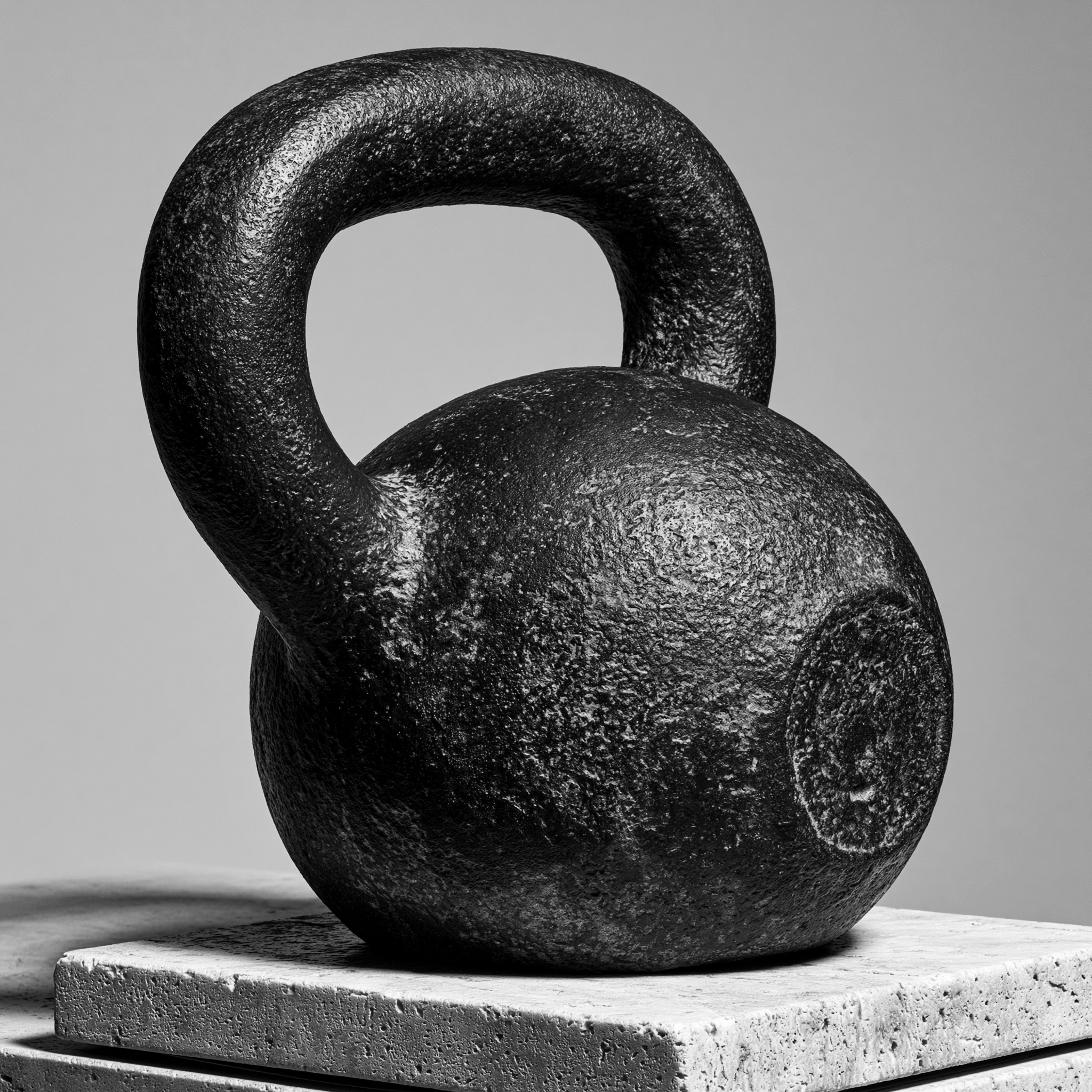
The Bell as Art.