You will hear people call the kettlebell swing a beginner exercise. They are not wrong, but they are not telling you the whole truth either. The swing is where most people start, and it is also where most people plateau, and the distance between those two points reveals everything worth knowing about how the human body generates force after fifty.
The swing is the first ballistic movement in the kettlebell vocabulary. Unlike the goblet squat, which is grinding and deliberate, or the Turkish get-up, which unfolds like a negotiation with gravity conducted one joint at a time, the swing happens fast. The bell leaves your hands' control for a fraction of a second at the top of every rep. You launch it, and then you receive it. Between those two moments lives the entire education.
The Hinge Is the Point
Every kettlebell swing begins and ends at the hip hinge, and if you are over fifty, the hip hinge may be the single most important movement pattern you will ever relearn. Notice that word: relearn. You knew how to hinge as a toddler. Watch any two-year-old pick up a toy from the floor and you will see a perfect hip hinge, the spine neutral, the knees soft but not collapsed, the work happening exactly where the body's largest muscles can handle it. Somewhere between that toddler and your desk chair, you forgot.
The modern sedentary body defaults to spinal flexion. You bend at the waist instead of hinging at the hip. You round forward to reach the floor, loading your lumbar vertebrae with shear forces they were never designed to manage in isolation. For a twenty-five-year-old with healthy discs and dense connective tissue, the body tolerates this abuse quietly. For a fifty-year-old whose discs have been slowly dehydrating for two decades, whose facet joints have been accumulating microtrauma from years of sitting and compensating, that tolerance has a limit. You find the limit when you reach for a suitcase or lean over a sink and something in your lower back announces, with searing clarity, that it is finished negotiating.
The kettlebell swing retrains the hinge under load and at speed. That combination matters. You can practice bodyweight hinges all day and build decent pattern awareness, but the swing forces the pattern to hold under real demand. The bell wants to pull you forward and round your spine on the backswing. Your posterior chain, the glutes, the hamstrings, the spinal erectors, must fire in coordinated sequence to prevent that collapse and then redirect the bell forward through hip extension. This is not a theoretical exercise. It is applied spinal mechanics with immediate consequences for failure, because a sloppy swing with a 16kg bell will teach your lower back a lesson you did not sign up for.
Ballistic Versus Grind
Kettlebell movements divide into two families. Grinds are slow and controlled: the squat, the press, the get-up. Ballistics are fast and rhythmic: the swing, the clean, the snatch. The distinction matters because each family trains the nervous system differently, and both families are necessary for a body that needs to function in an unpredictable world.
Grinds teach you to produce force steadily against resistance. They build the structural strength that keeps joints stable and bones dense. If the grind is a paragraph, carefully constructed, every word bearing its share of the argument's weight, then the ballistic is a sentence that lands before you fully see it coming. Ballistic movements train the body's ability to produce force rapidly and then shut it off, what exercise scientists call the stretch-shortening cycle. Your muscles load eccentrically on the backswing, store elastic energy in tendons and fascia, and release it explosively through hip extension on the upswing.
This capacity is not a luxury after fifty. It is a survival skill. Falls happen not because people lack strength but because they lack the speed to recover from a stumble. The body that can only produce force slowly is the body that watches the ground approach with full awareness and insufficient response time. Ballistic training, the swing chief among its tools, maintains the fast-twitch motor units that atrophy first with age and disuse. Every swing rep is a rehearsal for the moment you catch your toe on a curb and need your hips to fire fast enough to pull you back to vertical before gravity finishes its work.
The Paradox of the Float
There is a moment at the top of a well-executed swing when the bell is weightless. The hip extension is complete, the glutes have locked out, the arms are extended, and for a sliver of a second the bell floats. It weighs nothing. All that cast iron, momentarily free of your effort.
This is the part most beginners never reach, because they are too busy muscling the bell upward with their arms and shoulders. They treat the swing as a front raise performed with unnecessary drama. The bell gets to chest height through deltoid effort, and the hinge becomes an afterthought rather than the engine. Their shoulders burn after thirty reps. Their backs ache. They conclude that the swing is not for them, or that they need a lighter bell, or that kettlebell people are exaggerating when they describe the swing as the foundation of everything.
What they have not yet discovered is that the swing's power comes entirely from the hinge, and the arms are just the cables connecting the engine to the load. When the hinge fires correctly, the bell floats because it has nowhere else to go. The hip extension launches it forward and up along an arc determined by physics, not by shoulder effort. Your arms stay straight and relaxed. Your grip holds the handle but does not steer the bell. You are, for that fraction of a second, not working at all. You are witnessing the result of work that already happened.
This is where the swing becomes philosophical, if you will permit a kettlebell article that much ambition. The float teaches you that the most powerful moment in any explosive effort is the moment you stop pushing. The swing does not reward continuous tension. It rewards a precise alternation between effort and release, between the violent hip snap that launches the bell and the relaxed acceptance of the arc that follows. You cannot force the float. You can only set the conditions for it and let it happen.
For people over fifty who spent careers in environments that rewarded relentless effort, that rewarded staying late and pushing through and never letting up, the float is a strange and sometimes uncomfortable lesson. The swing says: your job is to be explosive for an instant and then get out of the way. The power is real, but it comes from timing, not from sustained exertion.
Breathing the Bell
Nobody talks enough about breathing in the swing, which is peculiar given that the swing's respiratory demands will expose your cardiovascular conditioning faster than any treadmill. A set of twenty heavy swings will have you breathing like you sprinted a hundred meters, and the reason is that the swing's breathing pattern is the inverse of what most people do under exertion.
In a properly executed swing, you exhale sharply at the top, at the moment of hip lockout, when the bell is floating and your entire body is a rigid vertical plank for an instant. You inhale on the backswing, when the bell is falling between your legs and your torso is hinging forward. This pattern matches the biomechanics: the exhale braces the core at the moment of maximum force production, and the inhale fills the lungs when the torso is in its most open position.
Most people do the opposite. They hold their breath on the way up, exhale vaguely at the top, and gasp reactively as the bell falls. Within ten reps their timing is gone, their faces are red, and they are breathing from the neck instead of the diaphragm. The set degrades not because the muscles failed but because the breathing failed, and once the breathing goes, everything built on top of it collapses. This is true in the gym and it is true everywhere else.
Programming the Swing After Fifty
There is a temptation, particularly among people who come to kettlebells with a background in other training modalities, to treat the swing as a conditioning tool and nothing more. They program hundreds of reps per session, chasing metabolic fatigue, treating the swing like a burpee with better marketing. This is a mistake at any age and a dangerous one after fifty.
The swing is a power movement. Its primary training effect is the development of hip extension force and the maintenance of fast-twitch motor unit recruitment. These adaptations require quality reps performed with full effort and adequate recovery between sets. A set of ten crisp, explosive swings with a bell that challenges your hinge pattern will do more for your body than fifty reps performed in a state of accumulated fatigue where each rep is slightly worse than the one before it.
For people over fifty who are training the swing seriously, a simple and effective approach is to perform sets of ten to fifteen reps with rest periods that allow full recovery of your breathing and your focus. Five to ten sets per session, two to three sessions per week. The bell should be heavy enough that you cannot muscle it with your arms but must rely on your hinge, and light enough that your form does not degrade before the set is complete. For most men over fifty, this means a 20kg to 24kg bell. For most women over fifty, 12kg to 16kg. These are starting points, not ceilings. The swing accommodates progression indefinitely, and a strong practitioner of any sex can eventually swing bells that would have seemed absurd in the first month.
The key variable is not volume or weight. It is the quality of each individual hip snap. Every rep should sound the same, look the same, and feel the same. When a rep feels sluggish or the bell fails to float, the set is over regardless of where you are in the count. You are training a pattern, not performing a penance.
What the Swing Teaches
The kettlebell swing, performed correctly over months and years, teaches the body a lesson that no other single exercise delivers as efficiently: you are more powerful than you believe, and the source of that power is not where you thought it was.
It is not in your arms. Your arms are connectors. It is not in your back, though your back works hard to maintain its neutral architecture. The power is in the hinge, in the coordinated explosion of the glutes and hamstrings driving the hips forward, and it is available to you at any age provided you respect the pattern and refuse to substitute effort for technique.
The swing is where power learns to listen. It listens to the hinge. It listens to gravity. It listens to the breath. And if you are patient enough to listen back, it will teach you that explosive strength and thoughtful restraint are not opposites. They are dance partners. The best swing you will ever perform is the one where you did the least unnecessary work and produced the most honest force.
Pick up the bell. Hinge. Snap. Float. Repeat.
Ring them Boles Bells.
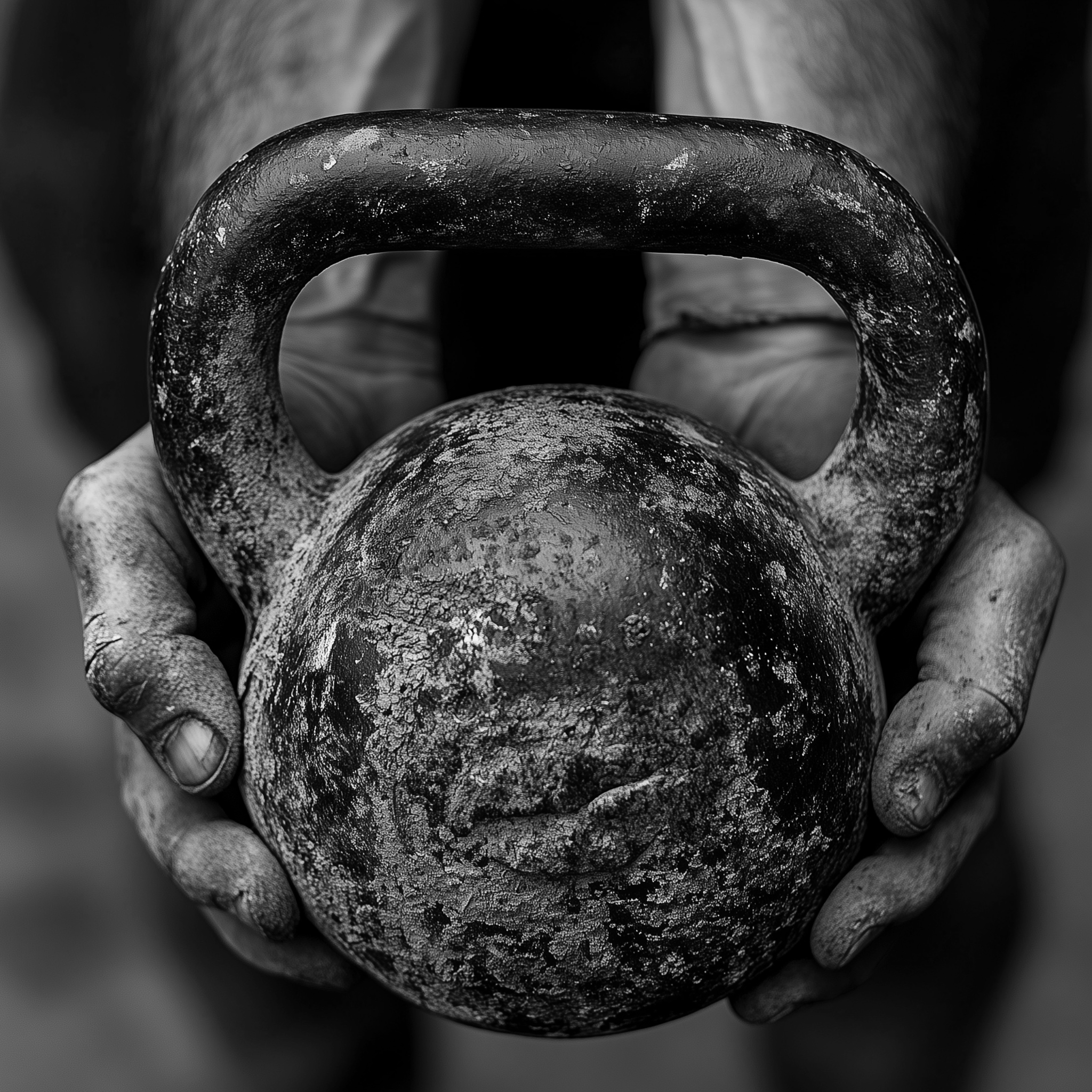
Hold ‘em and weep!